
Canadian Analytical Solutions
Analytical solutions for the most demanding applications
Systems designed to meet the challenges of your process.
Whether it’s petrochemical, natural gas, greenhouse gases, breathing air, specialty gases, foods and beverages, pharmaceutical, agriculture, our instruments are designed to work in the most demanding environments.
Canadian supported, validated in our Edmonton laboratory, installed by our certified technicians, they are built to meet your real needs.
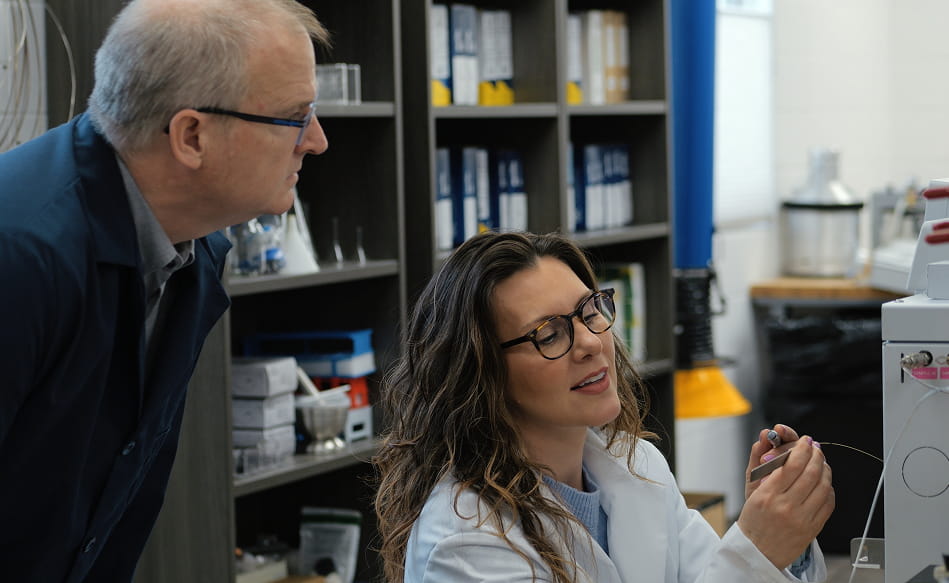
What we're hearing from Canadian laboratories
What we see in the field, the real problems our customers face
Set between sample introduction and data processing, the instrument is at the heart of your workflow. This is where the analysis happens. Choosing the right method, columns and detectors may seem simple but when accuracy, reproducibility, sensitivity, throughput and ruggedness are non-negotiable, you need someone who understands both the science and how to apply it to your specific situation. Performance specifications don’t mean anything if they don’t solve your specific problem.
Here are some real-life challenges we have helped our customers address
Speciated Sulfur in Natural Gas and Hydrocarbon Streams
Natural Gas Composition
Dissolved Gas Analysis in Transformer Oil
Renewable Natural Gas Analysis
High Pressure Breathing Air Analysis
High Throughput Green House Gases Analysis
Our numbers drift and we can’t explain why
Sulfur numbers creep between runs. Calibration checks pass at noon and fail at 4pm. The instrument looks fine on the front panel, but repeatability is slipping and nobody can point at a single root cause. The real answer is usually a method or flow-path issue nobody’s had time to revalidate since the original install.
We just failed an audit on a method we’ve run for a decade
The regulated method quietly changed. The reporting requirement changed also. Your system didn’t. Now you’re rebuilding method documentation under pressure, and the people who set it up originally aren’t in the building anymore.
Our last supplier sold us hardware and disappeared
Commissioning stalled. Calls aren’t returned. The instrument works for the easy samples and fails on the ones that matter. You need a partner who will stay engaged long enough to finish the job properly, and still be there when the method changes again.
There is no reason you should be compromising on the performance of your instrument. Talk to us about designing a system that meets your specific requirements.
Here's how we'd approach it
Let’s start with what you want to do
We don’t lead with an instrument. We lead with the process the measurement has to support. Before we recommend anything — GC, MS, IR, columns, detectors— we work through a short set of questions with your team. The goal is simple: make sure the system we design matches the problem you’re solving, now and in the future.
Five questions we start with
- Why does this analysis matter to you, your process and your organization
- How are you doing the analysis now and how is it working for you?
- What is your sample? Gas or liquid, temperature, pressure, moisture content, and what else is or could be in it.
- What concentrations and linear range matter? If you’re proving absence, what threshold defines “not there”?
- How many samples per day or week, and how are they collected?
- What regulated method applies, if any, CCME, ASTM, CSA, Measurement Canada, Health Canada, ISO?
- How do you process and manage your data and how do you report results?
The answers decide the configuration. Everything else flows from there.
Honest Recommendations
We’ll recommend what you need, nothing more, nothing less. If a GC will do the job and a GCMS is overkill, we’ll let you know. If the application needs the MS, we’ll let you know also.
Application Areas
Where our systems are hard at work
Four broad categories, many specific problems underneath. The common thread: each system is scoped, configured, and validated against your real samples, not a generic factory spec.
Petrochemical
Pipelines, refinery, and heavy crude measurement
Pipeline operators, refineries, natural gas processors, and bitumen laboratories rely on measurements that carry financial and regulatory consequences on every run. We design the full analytical system, sample introduction, flow path materials, column selection, calibration approach, against your matrix and your regulated method, not a generic configuration.
Where the regulation is Measurement Canada, we build the BTU normalization into the Compass report, so the laboratory doesn’t have to make that calculation manually. Where the stream is heavy Canadian crude, the SimDis system is validated against actual Athabasca bitumen before it ships.
Where the program is environmental remediation, the CCME F1-F4 and BTEX workflow is integrated correctly in Compass with apex-to-apex integration, not patched on after the fact.
- Sulfur in NG, LPG, refinery — ASTM D5504 / D5623, pipeline acceptance, custody transfer
- Measurement Canada natural gas — Full C1 to C12 speciation with automated BTU normalization
- Simulated distillation — ASTM D2887 / D7169, validated against Athabasca bitumen
- CCME F1-F4 and BTEX — Apex-to-apex integration built into Compass
Scion 8500 GC · Scion 8300 GC · Compass CDS · Restek columns and consumables
Environmental gases
Greenhouse Gas
GHG monitoring is as much a sample management problem as it is a measurement problem. It’s all about speed and throughput. Peak seasons overwhelm manual workflows, and reporting deadlines don’t move.
We configure complete systems for CO2, CH4, and N2O with automated Vacutainers sample management through our custom-configured autosampler (up to 200 samples unattended) and Compass Merge for consolidated multi-channel reporting. With a run time of under 4 minutes sample to sample, you’ll get through your backlog in no time.
- CO2, CH4, N2O — Single-instrument multi-channel configuration
- Up to 200 vacutainers — Gas autosampler, unattended operation
- Under 4 minutes — All analytes
- Compass Merge — Consolidated multi-channel reporting in one file
Scion 8500 GC · Vacutainer autosampler · Compass CDS · Compass Merge
Compressed air
Breathing air
With breathing air, a missed contaminant is a life-threatening safety failure. We design and validate multi-component systems to CSA Z180.1 — O2/N2 balance, CO, CO2, CH4, total hydrocarbons, and halogenated hydrocarbons down to the 5 ppm limit with a full validated method and documented performance trail behind it.
Third-party testing laboratories, fire and scuba certification facilities, hospital compressed-air programs, and hospital emergency laboratories running blood alcohol and ethylene glycol all use variations of the same underlying approach, deployed as a practical two-method setup on a single GC with full IQ/OQ and on-site training.
- CSA Z180.1 — Full multi-component validated method
- 5 ppm halogenated HCs — Documented down to the regulatory limit
- Two methods, one GC — Blood alcohol and ethylene glycol hospital configuration
- IQ/OQ + training — On-site handoff, not a catalogue delivery
Scion 8300 GC · Scion 8500 GC · Compass CDS · IQ/OQ documentation package · 8900 GCMS
Specialty gases
Industrial gases
Specialty and industrial gas work lives at the limits of what standard GC configurations can do. Detection limits are in the ppb or sub-ppb range, bulk gas co-elution masks the impurities you’re trying to find, and even trace moisture contaminates the entire system.
We’ve spent years mastering these configurations, including applications where no published method existed when we started.
For nuclear and heavy water applications, we developed a custom cryogenic column operating at -196°C to separate hydrogen isotopes including H2, HD, and D2, a capability previously unavailable at this price point and now sold as a standalone product.
For noble gas producers and specialty gas laboratories, we developed a novel midpoint pressure valve technique that resolves trace impurities in bulk krypton and xenon at detection limits lower than any known existing technology.
For transformer utility laboratories, the ASTM D3612 dissolved gas analysis workflow is configured with the correct extraction method and Ostwald coefficient handling for the specific oil type and temperature regime. These systems are scoped from the first conversation with our senior technical team, always.
- Hydrogen purity — ISO 14687 / SAE J2719 full impurity suite, ppb level
- Xenon / krypton trace — Novel midpoint pressure valve technique, ultra-trace detection
- Ammonia and amines — Fully inert flow paths, base-deactivated columns
- Transformer DGA — ASTM D3612, correct extraction and sampling for the oil
Scion 8500 GC · Scion SQ MS · Scion TQ MS · PDHID · PFPD · Compass CDS
What this looked like
Word of mouth, how a peer referral became a long-term partnership.
A Canadian natural gas operator was looking for a better analytical solution, and the introduction came not from a sales call, but from a peer at another operator who had worked with us for nearly two decades.
Before committing to anything, they toured a working Scion Instruments Canada installation at that peer’s facility, seeing a directly comparable application running reliably in an environment they recognized.
That visit did more than any demonstration we could have arranged ourselves. They came in with confidence, we got to work, and what started as a single system has grown into one of our most collaborative long-term relationships.
It’s how many of our best partnerships begin, not with a pitch, but with someone they already trusted saying: talk to Scion.
1 + year
Incumbent commissioning without usable data
2 decades
Length of the peer relationship that made the referral
Most
Long-term Scion customers started from a similar peer introduction
Platforms we work with
Scion 8300 GC
Focused, single channel application configurations in a smaller footprint. Pairs cleanly with headspace and liquid autosampler options for dedicated workflows.
Scion 8500 GC
Multi-channel analysis with independent heated zones for complex, simultaneous workflows. The workhorse for GHG, specialty gas, and refinery applications.
Scion SQ MS
Single-quadrupole mass spec for identification, confirmation, and library search where the method or the unknown genuinely requires it.
Scion 8900 TQ MS
Triple-quadrupole for trace-level quantitation in complex matrices. Used where sensitivity and selectivity is essential.
Compass CDS
Data system for instrument control, data acquisition, custom calculations, custom integration, reporting, compliance modules, and client-server deployments. The layer that pulls it all together. Data system for instrument control, data acquisition, custom calculations, custom integration, reporting, compliance modules, and client-server deployments. The layer that pulls it all together.
Not sure which platform fits your application?
Tell us what you’re trying to measure.
Every Scion engagement starts with a scoping conversation, questions about your workflow, your regulated method, and what your current system does well and poorly. We have nothing to sell you until we understand the problem you need to solve.