
Canadian Data Systems
Get your results, how you need them, when you need them.
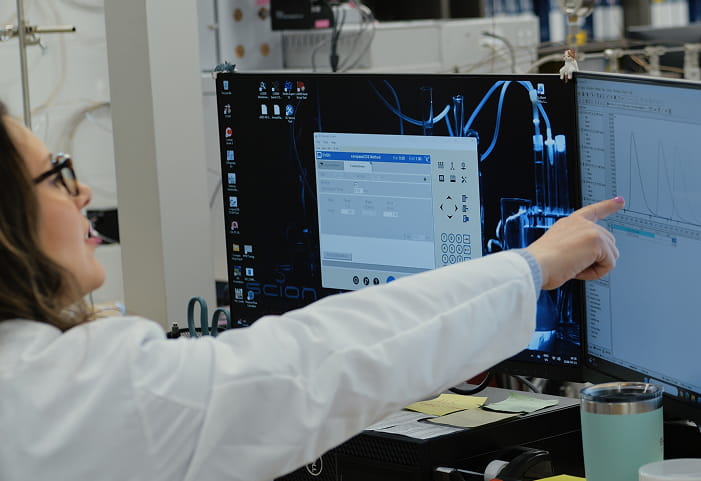
Compass CDS is more than chromatography software. It controls every function of your GC. It handles the running parameters, data acquisition, and analysis, reporting, and compliance. As a standalone workstation or as part of a client-server configuration it’s what makes Scion systems adaptable to complex and regulated analytical environments across Canada.
What our customers ask us
What our customers need to know about Compass
This page exists to answer them directly, in simple and plain language.
Can your software work with our existing IT infrastructure?
Yes. Compass CDS runs on standard Windows, can be deployed as standalone workstation or in a client/server configuration, and connects to LIMS, ERP, and compliance systems.
For sites with formal IT governance, we recommend IT involvement from the first conversation. For client/server deployments IT involvement is a must.
Can it run our existing instrument?
Yes. Compass CDS has drivers for a wide range of GC instruments including Varian and Bruker legacy systems and even instruments from other manufacturers. Many Canadian laboratories are getting inadequate software support from their historical instruments’ suppliers.
Running Compass CDS on existing hardware keeps the laboratory operational on a single modern data system, instead of replacing instruments that still do the job.
Does it support the compliance work our regulator demands?
Yes. The integrated 21CFR11 module handles electronic records and signatures. When the module is activated every acquisition and processing step is logged and traceable. If your regulator asks for an audit trail, it’s all in there, ready to work with your operating procedures.
We even offer IQ/OQ certification at installation and any time you need it.
There is no reason you should be transferring data on memory sticks or doing calculations in Excel. Talk to us about automating your data handling and processing.
What compass does for you
Instrument and peripherals control, automation, data acquisition and processing, reporting, and the compliance layer in one versatile platform.
Compass CDS is the operational foundation for every Scion GC. It controls all instrument parameters, acquires and processes data, generates custom reports with built-in calculations, exports to your LIMS, and handles the compliance regulated laboratories need. Configured for your applications, it streamlines your work and shortens the path to getting results.
Instrument Control
Drives every function of the GC
Compass CDS is the nervous system of your instrument. It controls all hardware components – stream selector, valves, autosampler, injector and detector – it controls the conditions of the instrument – temperatures, flows, and pressures – it acquires and processes the data from all the detectors, and it generates the final report with actionable results.
Compass CDS drives the peripherals, autosamplers, valves, injectors, detectors, the ovens programs, and the carriers flows. It runs programmed sequences unattended, calibration injections, QC checks, stream switching through SSV valves, sample runs all queued in advance and executed overnight without an operator in the laboratory.
On the acquisition side, it integrates peaks, applies calibration, performs quantitation, runs system suitability checks, and calculates signal-to-noise. For complex calculations — BTU normalization for natural gas, SimDis residue recovery for ASTM D7169, CCME F2-F4 apex-to-apex integration, system suitability for CSA Z180.1 breathing air, the math is built into the report template, so nobody is doing it by hand.
- Full instrument control — Injectors, detectors, valves, autosampler, oven, gases
- Sequence automation — Unattended overnight operation with QC checks and calibration
- Built-in calculations — BTU, SimDist, CCME F2-F4, CSA Z180.1 suitability
- Custom reporting — Template-driven, multiple detectors, flexible, regulator-ready
Drivers and integration
Current Scion, legacy Varian and Bruker, and additional manufacturers in one data system.
Compass CDS uses instrument drivers to communicate with each GC model. Scion maintains drivers for every current Scion platform (8300, 8500), legacy Varian and Bruker systems including the micro GC, and other manufacturer’s hardware.
Many Canadian laboratories have legacy systems from other manufacturers which no longer offer software support. Those laboratories can run Compass on their existing hardware, keeping the instruments operational on a modern data system while we help them plan whatever transition makes sense.
On the LIMS side, Compass Link imports sample data directly into Compass sequences so nobody is keying samples in by hand.
- Scion 8300, 8500 — Current Scion GC drivers, standard with all new systems
- Legacy Varian — 3800, 450, 456, 436, micro GC — full driver range - Actively supported and actively promoted
- Compass Link — LIMS sample data imported directly into sequences
Scion 8500 GC · Scion 8300 GC · Varian CP-3800 / 450 / 456 / 436 / micro GC · Compass Link
Enterprise and Compliance
Built for regulated environments and large multi-instruments sites.
For pharmaceutical, cannabis, and hospital laboratories, the 21CFR11 module handles electronic records and signatures to the FDA standard.
For large industrial sites, client/server architecture puts Compass CDS on a central server with any instrument operable from any networked workstation and centralized data storage under IT governance.
Deployment requires IT department involvement, which we flag on the first call so expectations are clear. For high-volume laboratories running multiple simultaneous detector channels, typically GHG work running CO2, CH4, and N2O in parallel, Compass Merge consolidates the channels into a single unified report instead of leaving analysts to merge CSVs by hand.
- 21CFR11 module — Electronic records and signatures, FDA-grade
- IQ/OQ documentation — Generated at install and annually, regulator-ready
- Client/server — Any instrument from any workstation, centralized data
- Compass Merge — Multi-channel consolidated reporting (primary use: GHG)
Scion Built Software
Three tools we built because customers needed them
These are Scion Instruments Canada developed packages. That’s the agility of a Canadian company serving Canadian customers.
We see a need and we develop a solution. The three current tools:
Compass Merge: Consolidates multi-channel data from multiple simultaneous detectors, primary application is GHG but useful for any applications with multiple channels
Compass Link: Imports LIMS sample data directly into Compass sequences, eliminating manual entry and transcription errors
PFPD Automatic Tuning Software: Automates setup and optimization of the pulsed flame photometric detector for sulfur and phosphorus analysis.
What this looked like
Same hardware, new software, problem solved
Canadian natural gas operator was told by their historical supplier that all their GCs needed replacement to comply with Windows 11 requirements.
The quoted replacement cycle was significant, and it turned out to be based on a software compatibility claim that wasn’t actually true. We demonstrated Compass CDS running on their existing hardware under Windows 11, maintained a single data platform across the mixed fleet, and helped them plan the transition to new instruments on their timeline instead of the other vendor’s.
No forced replacement, no throwaway hardware, no operational disruption. Nobody else offered this. The multi-vendor driver capability is the reason why.
0
Instruments replaced unnecessarily
1 platform
Compass CDS running the mixed fleet across Windows 11
Customer’s timeline
Transition planned around their operational reality
Tell us about your instrument fleet. We’ll tell you what Compass CDS can do with it.
Whether you’re scoping a new system, planning a LIMS integration, preparing for a regulator, or trying to keep a mixed fleet running on one data platform, the conversation starts with your setup and your requirements. No proposal before we understand the workflow.
Tell us what you are measuring, where the sample is, and what is not working. We will map the path from source to result and show you where improvements will have the most impact.